
A History of Area Measurement
Sometimes in a conversation, you can hear: “I have a garden plot – seven acres” – and everyone knows what we are talking about. A hundredth of a hectare or a hundred square meters. But you can say otherwise: "I have a plot of seven ars." After all, ar (derived from the Latin "area" - area) is just 100 m2. Ar is the unit of measurement of area in the metric system of measures, which was used before the introduction of the International System (SI). The well-known word "hectare" is formed from the word "ar" with the help of the prefix "hecto", meaning "hundred". Therefore, instead of "hundreds" you can say "ar", however, in this case you may not understand, so firmly this word has fallen out of use, which can not be said about other units of the old system of measures. We are still more accustomed to express atmospheric pressure, pressure in millimeters of mercury, not in pascals, the power of the car engine - in horsepower, not in watts, etc.
The need to measure the area arose in a person when he began to move from a nomadic lifestyle to a settled one. Occupation with agriculture, construction of dwellings, other activities required measurement of the area.
In the beginning, people were satisfied with the subjective measures common to the inhabitants of a certain territory. So, for example, in South India, the unit of measurement of area was a piece of land that occupied the sheep’s corral. In Russia, such a measure was a "plough" - a part of the field that could be plowed on a pair of oxen in a day. In America, the Indians, when buying land as a unit of measurement, took the territory that a person could promise in one day. Therefore, buyers usually hired the fastest runner for this purpose.
A similar story is told by L.N. Tolstoy in the parable "Does a man need much land?" Her hero, the man Pakhom, buys land. For 1000 rubles, he is transferred to the property, which he will be able to bypass in a day. Of course, a man wants to get for his money as much land as possible. He rushes, rushes, and drives himself to death. As a result, Pahom receives, like any deceased, three yards of land. “The worker lifted up the scraper, dug up the grave of Pakhom, exactly as far as he had taken three yards from head to foot, and buried it.” This is how the writer ends his story.
The fact that different measures of length, weight, area, etc. existed in different countries was inconvenient. This hindered the development of trade and crafts, and in 1791 the National Assembly of France, on the proposal of the Commission on Weights and Measures of the Academy of Sciences, approved a new system of measures, which, in the opinion of its creators, was suitable "for all times and for all peoples." In accordance with this system, length was measured in meters, weight in kilograms, and land area in araches.
In 1875, 17 countries, including Russia, signed the Metric Convention, under which they pledged to introduce in their countries a system of measures developed by French scientists. But for a long time local measures were used everywhere. In Russia, these were ancient measures, legalized by Peter 1. Here they are and their translation into modern units of measurement.
Square (sq.) verst = 250,000 sq. sazhens = 1.1381 km2; ten on = 2400 sq. sazhens = 1.0925 ha = 10,925 m2; sq. sazhen = 9 sq. arshin = 4.5522 m2; sq. arshin = 256 sq. tops = 0.50558 m2; sq. top = 19.758 cm2.
It was only after the Great October Socialist Revolution that the metric system became mandatory throughout Russia; on September 14, 1918, the decree "On the Introduction of the International Metric Decimal System of Weights and Measures" was adopted. Finally, this system came into use in the USSR since 1927.
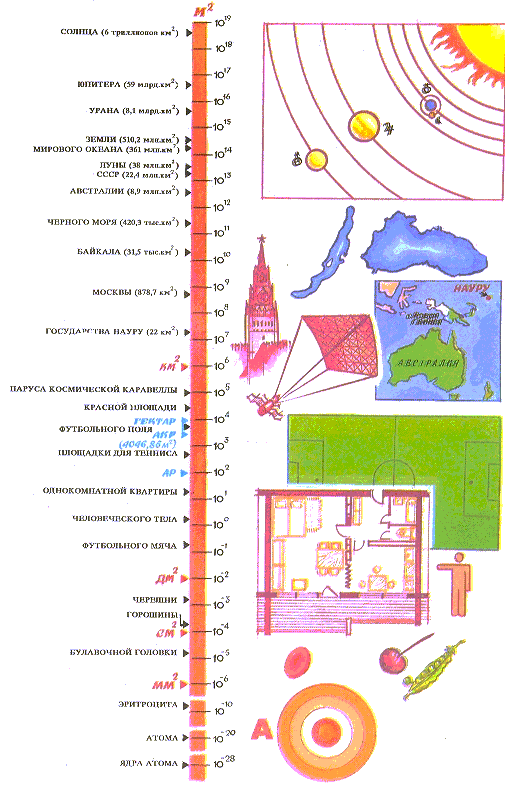
The figure shows various areas known and unknown to you: the surfaces of the Sun and Earth, the World Ocean and the Black Sea, the human body and the erythrocyte. To depict all this diversity in one figure, a logarithmic scale is used: two adjacent divisions differ from each other in magnitude ten times. The word "sun area" should be understood as "surface area of the sun". In the upper part of the figure, the exact values of areas and territories are given, and in the lower part, the average values are given (and peas, and cherry berries, and people come in different sizes) and the order of values (for the surfaces of the atom and its nucleus).
The figure shows ar, hectare and other units of area measurement. Looking at the picture, you will find the area of a football field and the surface of a football, learn that the surface area of the moon is only 1.7 times larger than the territory of the Soviet Union, determine the size of Moscow and the tiny state of Nauru, which is 7 times smaller than Liechtenstein, and Singapore – 28. The figure also contains many other data for comparison and reflection.